
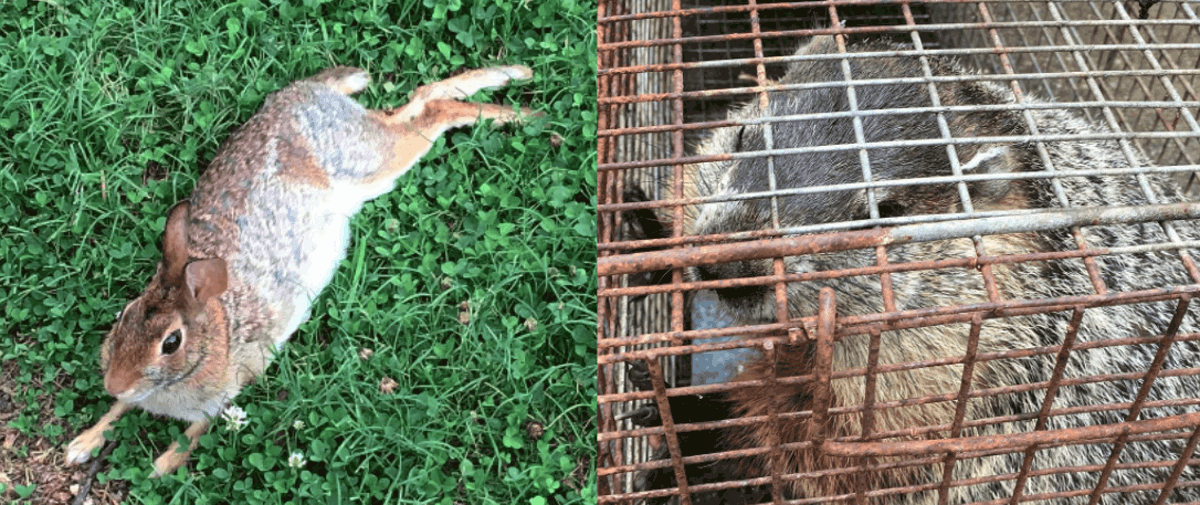
How to keep pest animals out of your garden
As an Amazon Associate, GrowJourney earns from qualifying purchases. Read more: terms of service.

Use the helpful tips in this article to keep common pest animals out of your garden or yard, including groundhogs, deer, possums, skunks, squirrels, chipmunks, voles, and cats.
Your garden should feed you, not just pest animals.
We get a lot of emails and social media comments that read like this: “I love to garden, but [insert animal name] keeps eating or destroying everything I grow. What should I do?”
Hey, we get it! You’re growing food for you and your family, not for your furry neighbors. Having dealt with all manner of pest animals over the years, we thought we’d provide you with a quick rundown of remedies we’ve found effective for the following four-legged garden pests:
- groundhogs
- deer
- possums
- skunks
- squirrels
- chipmunks
- voles
- rabbits
- cats (they might not eat your veggies but digging and treating your garden like a litter box isn’t ideal).
Also note that every animal species listed in this article is thriving based on population numbers. That’s because humans create ideal habitat that supports far more of them than would be possible in truly wild habitats. Pet food bowls, bird feeders, trash cans, food gardens, “edge” habitat… what more could they ask for?
Four important caveats:
Before diving into this list, we’d ask you to adopt as humane/thoughtful a philosophy as possible towards our furry friends and consider these three important caveats:
1. Deterrence first
Exhaust every deterrence method first BEFORE resorting to trapping/relocating or killing an animal. Why?
- There are low survival rates for relocated animals and you might be taking a nursing female away from her nesting young.
- Other animals of the same species will soon fill the void left by the animal(s) you relocate.
So it’s better to figure out how to coexist and deter the pest animals in your area from eating your garden, rather than engage in constant deadly battle.
3. Relocation vs killing
If you’re determined to either relocate or kill an animal, opt for relocation. However, keep in mind that local or state laws actually require you to kill rather than relocate trapped animals such as groundhogs, so this isn’t always so easy.
Also, when relocating, you’ll likely need to take an animal 3-5+ miles away (depending on species) from you or it’s likely to find its way back. Release any animal you trap in a rural area away from other homes so they don’t become someone else’s pest. Choose high quality habitat to increase the chance of survival (example: put a trapped groundhog in a rural area full of kudzu, an invasive plant species they love to eat.)
3. Nursing animals/mommas
During spring-early summer, there’s a pretty good chance the wild animal eating food from your garden is a nursing mother.
For example, if you see a raccoon out during the day from spring through early summer, this is a very good indication that she’s got a den of nursing kits to take care of NOT that she’s rabid. Foraging all those extra calories to feed her young requires her to come out during the day, not just at night.
If you trap and relocate a nursing raccoon mother, her babies will die. Instead, try deterrence methods first. As a last resort, consider offering alternative food (a bowl of cat food) for a few weeks to draw her away from your garden produce. Or if it’s a serious problem, consult a wildlife rehabilitation professional who might be willing to help you figure out a better solution for your specific situation.
4. Avoid poisons
Putting out poisons to kill wild pest animals can have lots of negative second and third order consequences. Perhaps you accidentally poison your neighbor’s cat or dog instead. Or perhaps the animal you poison to death gets eaten by other animals (example: eagle or owl) who is then killed or feeds the poisoned meat to their babies.
Our recommendation: never use poison to kill pest animals in your garden. Opt for safer more humane methods instead.
How to keep animals out of your garden
We hope the list below will help you safely and permanently keep your most hated pest animals out of your garden:
1. Keeping GROUNDHOGS out of your garden

Groundhogs are also known as “woodchucks” in some parts of the country. One spring, we had a single groundhog clear out an entire bed of lush greens in a single day. And we’ve lost track of how many melon and pumpkin patches they’ve destroyed.
Scaring them off will work temporarily, but trust us: they’ll keep coming back when you’re not around to finish off what they started. Since they can dig and climb pretty well, fencing is likely only a temporary solution.
What to do? The only deterrence methods we know of that are effective for groundhogs are electric fencing or row covers.
What if those options fail or you have a serious groundhog infestation? If it’s legal in your state, trap and relocate them. (Yes, this is illegal in some states.)
(Here’s a good trap that will pay for itself rather quickly if you have serious groundhog problems.)
What’s the best bait to trap groundhogs?
We tried multiple types of bait to catch the rogue male groundhog that was ravaging our garden one summer. Nothing worked… until we tried cantaloupe. Leave a trail of a few small pieces of cantaloupe leading into the trap to draw the groundhog in.
Once trapped, relocate your groundhog asap to:
- a rural location that is not near a pasture with livestock in it (livestock can break their legs in ground hog holes);
- a location at least 5 miles away from your home to prevent the groundhog returning;
- a spot that provides good habitat for the groundhog, such as a lush kudzu patch.
2. Keeping DEER out of your garden
Deer can make life absolutely miserable for edible gardeners and landscape gardeners alike. There is no shortage of expensive contraptions that you can buy to fend off deer.
My dad tried nearly all of them before stumbling on to an incredibly simple and inexpensive solution: fishing line. Yes, fishing line.
You can read exactly how to keep deer out of your garden using fishing line on our sister website, Tyrant Farms. In addition to fishing line, we also detail other simple tricks to repel deer (no, Irish Spring soap doesn’t work) and deter them from eating individual plants.
3. Keeping POSSUMS out of your garden
What’s worse than having a possum eat the fruits and veggies out of your garden? Having your cat wake you up at 3am to tell you that a possum has come inside the house through the cat door to eat the cat food.
What’s worse than that? Having it happen multiple nights in a row.

Yes, this happened to me and my wife. Over the course of a week, we trapped not one, but three different possums that had learned about the all-a-possum-can-eat cat food buffet waiting for them inside the cat door.
Thankfully, the same trap that worked for our groundhog also worked for our possums. Since possums are marsupials who carry their young nurslings on them, you can humanely relocate the entire family, unlike with raccoons and other non-marsupial pests.
Possums also don’t seem to be nearly as destructive to garden plants as other animals.
What’s the best bait to trap possums?
We had 100% success baiting our possums with peanut butter rather than cantaloupe. (Cat food can work as a trap bait too, but it doesn’t stick on the trap lever nearly as well as peanut butter.)
4. Keeping SKUNKS out of your garden
Yes, skunks smell absolutely terrible when they spray, which they only do when they feel like their life is in jeopardy. After all, their spray is their primary line of defense against predators and it takes them about 10 days to reproduce this defensive substance, leaving them defenseless in the meantime.
In our experience, skunks do not do much, if any, damage to a garden, although they may eat ripe fallen fruit (we think skunks partake in some of our fallen pawpaw fruit each summer).
In past summers, we’ve had families of skunks living under our front porch and we coexisted just fine. The only damage we’re certain we can attribute to skunks is each fall when they dig small holes in our grass paths to eat underground grubs. We’re ok with that.
Best bait to trap skunks?
If you’re absolutely determined to get rid of your skunks, bait them with peanut butter and trap them (using the same trap used for groundhogs and possums). Do note that females trapped in the spring very likely have a nest of kits nearby; relocating the mother will kill them and likely her as well.

What to do once you’ve trapped a skunk
Now, here’s where it gets tricky: you have a trapped skunk that’s going to naturally be quite anxious. Naturally, you don’t want to get yourself or your car sprayed relocating them.
If you have a trapped skunk, do the following:
a. Get a large, old heavy towel or blanket.
b. Slowly walk towards the trapped skunk, talking in a low soothing voice. Skunks have terrible vision, but good hearing and smell, so this simply alerts it that you’re headed its way. (The last thing you want to do is surprise it from close range.)
c. Slowly put the blanket over the entire trap. Then, slowly lift the trap and wrap the blanket underneath the trap as well. Essentially, you’re trying to do two things: a) protect yourself from getting sprayed, and b) keep the animal as calm as possible by reducing any external stimuli/sense of threat.
d. Secure the trap + blanket in a truck bed or car trunk on top of plastic bags or liners. If the cage tips over during the ride, you may well end up with a skunk-sprayed trunk (not good), so be sure the cage is tied down or wedged in securely.
Once you’ve gone 3-5+ miles from your home to a good rural habitat, slowly and gently open the trunk and remove the cage plus blanket covering the cage. Place the cage on the ground, remove as much of the blanket as needed to open the cage, then release the skunk. (With our trap cages, we pry open the door with a long stick so the door doesn’t come slamming down again as the animal tries to make its way out.)
Again, skunks only do minimal damage to a garden, so only trap and relocate if absolutely necessary. It also bears repeating that females you trap during spring likely have a den of nursing kits nearby; relocating their mother will be a death sentence for them.
What to do if your cat or dog gets sprayed by a skunk?
Oh, and if your cat or dog has been sprayed by a skunk, despite what you may have heard, tomato juice does not remove skunk odor! On our sister website, we provide a detailed guide to help you get the skunk odor off of your pet.
Unfortunately, we’ve had to become experts at this technique thanks to our pet cat’s inability to learn that skunks are not his friend. In a one year span, he got sprayed by skunks six times!
5. Keeping CHIPMUNKS and SQUIRRELS out of your garden
Chipmunks are cute little creatures. Squirrels are pretty cute too. However, they also love our strawberries, ground cherries, and melons. What to do?
For starters, we have a cat that manages to keep most rodents away from our garden. (We keep our cat from killing birds using a number of methods, primarily Birdsbesafe collars.)

Between our cat, our neighbors’ cats, and native predators, the chipmunk and squirrel population is kept in check enough not to seriously threaten our fruit supply. You can use smaller traps to catch and release these pest rodents elsewhere, but new ones will soon fill the void. Thus, it’s best to figure out how to use fencing, row cover, and other deterrence methods.
For instance, if you’re simply trying to keep rodents from eating your melons (we’ve had that problem too), here’s a simple and 100% effective way to make melon cages to protect your melons from rodents.
6. Keeping VOLES out of your garden
Voles are probably our most hated and hard-to-deal-with pest. They’re basically an underground mouse that eats the roots of your plants. We often have them suck down entire plants, root systems and all. It’s like a plant horror movie.
Artichokes, onions, squash, strawberries, lettuce, chicory, peas, even young fruit trees… we’ve had voles kill all of these plants and more in our garden. They drive our cat crazy since he can hear them munching roots, but has trouble getting to them since they’re underground.
Sure, you can poison your voles, but then you have that same poison in your garden soil. Not to mention a poisoned vole could potentially be eaten by your pet or other wildlife, which means you’ve now created another problem.
What to do for permanent, safe solutions for your vole problems? It depends on the plants you’re trying to protect, but here are some viable solutions:
Fruit trees:
- Plant your fruit trees in large homemade 1/4″ wire mesh baskets buried underground (or you can buy wire baskets). The trees roots can grow through the openings but the voles can’t get inside the caging or close enough in to the plant to kill it.
- Plant daffodils in circles around your fruit trees. Daffodils are toxic and repellent to voles, and this keeps them away.
Bulbs & roots:
- We plant artichokes, alliums, and other bulbs/roots that voles LOVE inside “Vole King” wire baskets that you bury in the ground. These provides permanent protection. We haven’t lost a single plant grown in Vole King baskets.
Annual and biennial plants:
- Build vole-proof raised beds – If you’re using raised beds, install 1/4″ wire mesh in the bottom of the frame before you put the soil in. Make sure the wire mesh is held securely in place with u-shaped staple nails or voles will eventually find a gap and get in.
- Use root pouches – Grow vole’s favorite plants in inexpensive yet high-performing root pouches instead of in-ground (no assembly required). Or use large pots, although they’re more expensive than root pouches and don’t air-prune roots. Voles can’t get in to either one.
Whole garden vole deterrent? If you want to go high tech, you can use ultrasonic vole, gopher, and chipmunk spikes that help keep these pests out of your whole garden.
7. Keeping RABBITS out of your garden
Here’s something you might not know: the most common rabbit species in North America (especially here on the east coast) is the cottontail — and cottontail rabbits do NOT dig holes. Yes, you read that correctly. (Other species of rabbits like European rabbits do dig holes.)
This important detail means that materials such as temporary fencing penned securely to the ground (no need to bury it), permanent fencing, or cover cloth is a very effective rabbit deterrent for most gardeners in the US.
There are some regional rabbit species like the black-tailed jackrabbit that dig very shallow holes, but they’re unlikely to dig deep below fencing to get to your garden. However, if some other critter digs a hole under your fence (groundhog, dog, etc) a cottontail rabbit would likely use the hole, but they won’t dig it themselves.
How tall does a fence have to be to keep rabbits out?
Another surprising feature of cottontail rabbits is they’re NOT good jumpers. They’re lightning fast sprinters but their vertical jump is quite limited. That means even a 1′ tall fence can be highly effective at keeping rabbits out of your garden beds — as are taller raised beds!

We know these things from experience as well as from reading what other experts have to say. For instance, in our garden, we’ve co-existed with Eastern cottontail rabbits for over a decade and are even quite friendly with them (as are our ducks).
They have so much forage in our yard and they have so many predators that they almost never become a pest. One summer, a cottontail got so comfortable with us that it would forage right alongside us and our ducks in the yard each night!
Any time we want to protect a garden bed from rabbits, we simply put up 1′ tall temporary fencing — and we’ve watched rabbits forage the grass and clover just outside the protected beds without ever jumping inside to nibble our veggies.
8. Keeping CATS out of your garden
Yes, cats! As mentioned, we have a cat who helps us with rodent control. However, he can infuriate us by turning a freshly sown garden bed into a litter box. Or finding a patch of tender young seedlings to use as a bed.

Obviously, trapping and relocating your cat isn’t an option (ha!). Instead, when we’ve just planted or seeded new beds, we’ll lay our unused DIY concrete wire tomato cages down on the surface of the beds. This makes it all but impossible for our cat to do his “business” there, and he opts for easier targets.
Once the plants have started filling in, we remove the cages. Cats don’t seem to view beds with larger plants in them as a potential litter box.
You can also use row cover to keep cats out of your garden.
We hope these tips help you keep pest animals out of your garden, whatever your pests may be!




Two strands of electric fence about 6 inches apart keep raccoons and rabbits off my bowler hat and watermelon.
The raccoon mentioned above is one of what is digging up my plants at night, the same as the chipmunks, skunks, rodents, and other animals introduced. They might be the ones that are digging up your plants too.
Can I sprinkle hot pepper on the plants squirrel problem
Two strands of electric fence, about 6 inches apart keeps the raccoons and rabbits out of my cantaloupe and watermelon.
Yes, electric fencing is definitely an effective alternative for keeping animals out of your garden, but it can be a bit hard on the budget.
The Chicken Wire Cloche protects prized seedlings, lettuce plants and ripening strawberries from nibbling wildlife and curious cats.
We live in Florida and have iguanas which are not native to us. How do we handle?
Hi Ashley! Iguanas are not something we’ve ever dealt with so I can’t offer advice based on my personal experience, however here are some tips you might find helpful: https://www.gardeningknowhow.com/plant-problems/pests/animals/iguana-control.htm Good luck!