
The ultimate DIY passive solar greenhouse
As an Amazon Associate, GrowJourney earns from qualifying purchases. Read more: terms of service.
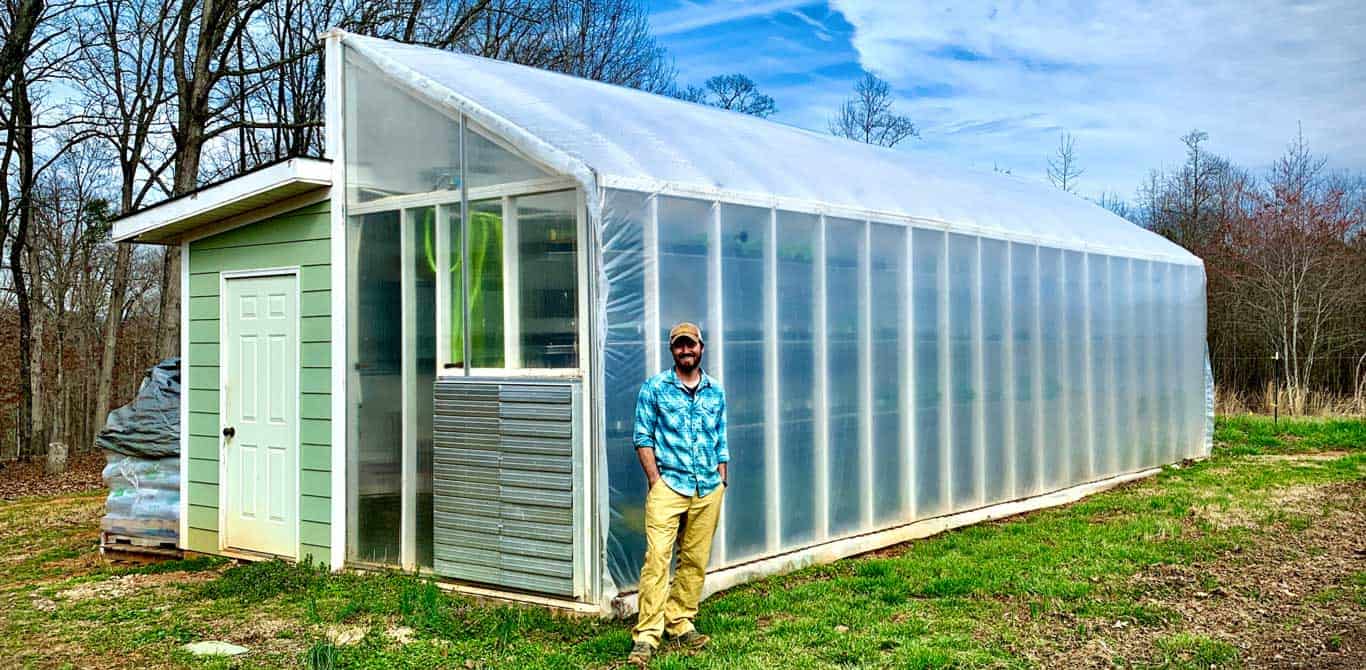
Looking for ideas and inspiration to build your own passive solar greenhouse? You’ll love the greenhouse our friend Ryan Merck at Blue Oak Horticulture built — and the final price tag!
I. Introduction to passive solar greenhouses
What is a passive solar greenhouse?
In case you’re not familiar with the term, a “passive solar greenhouse” is a greenhouse that is heated entirely by stored radiant energy from the sun.

How is a passive solar greenhouse heated?
Typically, sunlight entering a passive solar greenhouse is “captured” by strategically located, dark-colored water-filled barrels. Solar heat trapped in the water barrels during the day then slowly radiates back out into the greenhouse at night or when temperatures cool, assisted by fans which circulate the heat throughout the structure.
Materials other than water can also be used for thermal mass, but water barrels are considered the best option since water has a superior volumetric heat capacity:
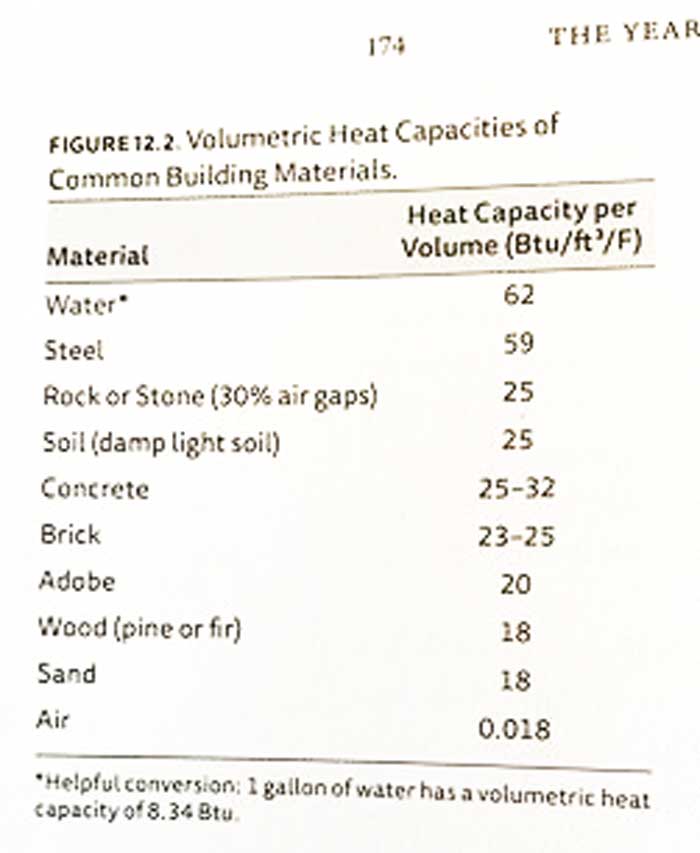
Thermal lag is the rate at which a material releases stored heat, and water-filled barrels are a nice slow-release heat source due to water’s unique properties. In a greenhouse, water barrels warm up slowly during the day, then slowly release that energy/heat when temperatures cool at night.
For reference, thermal lag is also what keeps the water cold at the beach until summer and makes peak hurricane season happen in the warm energy-filled oceans from August-October despite the summer equinox long having passed.
Orienting your greenhouse to maximize solar energy capture
In the northern hemisphere where we live, passive solar greenhouses are oriented to:
- Allow maximum sunlight in during the cold months via their south-facing walls and roofs which are made of glass, polycarbonate, or other clear materials (*these materials are collectively called “glazing”);
- Minimize heat loss on their north-facing walls and roofs, which are typically made of non-transparent building materials (siding, shingles, etc).
Dark-colored water barrels are placed inside along the north-facing wall. Sun coming in to the greenhouse via the south-facing side then heats the barrels during the day.
If you happen to live in the southern hemisphere, a passive solar greenhouse would be inversely oriented. You’d maximize sunlight entry on your north-facing surfaces and minimize heat loss on your south-facing surfaces.
What’s the temperature differential inside vs outside a passive solar greenhouse?
A well-made passive solar greenhouse will typically keep interior temperatures 10-30 degrees (Fahrenheit) warmer than the outside temperatures during the cold months.
Factors that can impact temperature differentials include:
- how far north you are (a passive solar greenhouse won’t work in Alaska and will be much cooler in Maine than in Kentucky);
- sunny vs. cloudy days;
- winter solstice proximity;
- quantity of thermal mass (more water barrels are better than fewer).
As Ryan says, the hardest time of the year to keep his greenhouse warm are on consecutively cloudy and cold days near the winter solstice when there’s minimal solar heat to capture.
“Two years ago the temp dropped to 43 on a 19 degree night. This was the lowest we’ve experienced outside of a cold three day cloudy period this December where the greenhouse dropped to 34.”

How much does a passive solar greenhouse cost?
The cost of a passive solar greenhouse can vary from hundreds of dollars to tens of thousands of dollars depending on:
- size of the structure,
- quality and type of materials used,
- amenities included,
- labor costs.
For reference, the passive solar greenhouse featured in this article is 36′ x 14′ (504 sq ft) and was completed in November 2019 at a total cost of $5,500 — $5,547.63 to be exact.
Materials were the only cost, since Ryan Merck (the owner and designer) built the entire structure himself.
Most people would be well-advised to have a licensed builder, electrician, or plumber involved when building a passive solar greenhouse like Ryan’s. However, Ryan is equal parts madman and savant, which is why we love him — and why he decided to DIY his greenhouse.

Are the energy savings of a passive solar greenhouse enough to offset the loss of growing space?
This was one of my first questions for Ryan… would you be better off using electric or gas heat for your greenhouse so you could use the entire structure for growing plants?
For him, the answer was no, he prefers zero annual heating costs. During years of experience working at the South Carolina Botanical Garden’s greenhouse, he noted how expensive it was to heat a greenhouse, whether you’re using electricity or fossil fuels. (At present, about 60% of electricity in the US is generated by fossil fuels.)
Given the uncertainty and fluctuation of energy costs from year-to-year plus his desire to operate as sustainably as possible, Ryan is willing to sacrifice growing space to have a solar-heated greenhouse.
How much electricity does it take to power a passive solar greenhouse?
Even though he doesn’t have to directly pay for heating & cooling, Ryan still has to have electricity to operate his greenhouse systems.
Wondering how much energy it takes to power a greenhouse similar to Ryan’s?
“The greenhouse added about $240 (1800kwh) per year to my power bill. Most of this expense is powering fans and small motors used for venting. There are also 4 germination mats that require 8.5 amps of power when being used from January to March. A greenhouse of similar size would use around $1000 of propane to heat it each winter and that would be in addition to the expense of fans, heat mats, etc.”
Saving $1,000 in heating costs each winter can quickly generate a good return on investment on a passive solar greenhouse versus a more conventional greenhouse.
II. Seven key features of a high-performance passive solar greenhouse
Do you want to build your own passive solar greenhouse? Here are the seven key features you need to keep in mind during the planning and implementation phases:
1. Maximum transparent south-facing walls and ceiling to let sunlight in
As detailed earlier, the south-facing wall and roof of your greenhouse need to let as much sunlight in as possible. If budget isn’t an issue, go with greenhouse glass which won’t ever have to be replaced.
Have a tighter budget? Go with twin wall polycarbonate, which also has relatively good insulating value. You will likely have to replace your polycarbonate glazing material in 15-20 years though.
In milder climates, you could even use polyethylene greenhouse film. However, you’ll need to plan to replace it in about 5 years.
What did Ryan use for glazing on his passive solar greenhouse? “I used twin wall polycarbonate on the endwalls and double layer poly with an inflation fan on the south wall and south roof.”
As for extending the life of his glazing, Ryan adds:
“I do think I tend to get more years out of plastic because I use Aluminet Shade cloth on the exterior of my greenhouses. It really helps reduce the UV load during the worst part of the year.”

2. North-facing walls and ceiling that are solid and insulated
The north-facing walls and ceiling of your passive solar greenhouse need to be designed to minimize heat loss.
For his walls, Ryan used standard stick-built framing with the following materials (from inside to outside):
- sheetrock,
- 2×4 studs,
- R-15 insulation bats (he also carefully air sealed gaps on the wall with spray foam to ensure a true R-15 value)
- ½” plywood sheathing
- vapor barrier
- cement board siding
His roof features 20-year shingles with R-30 insulation covered by sheetrock on the inside ceiling.
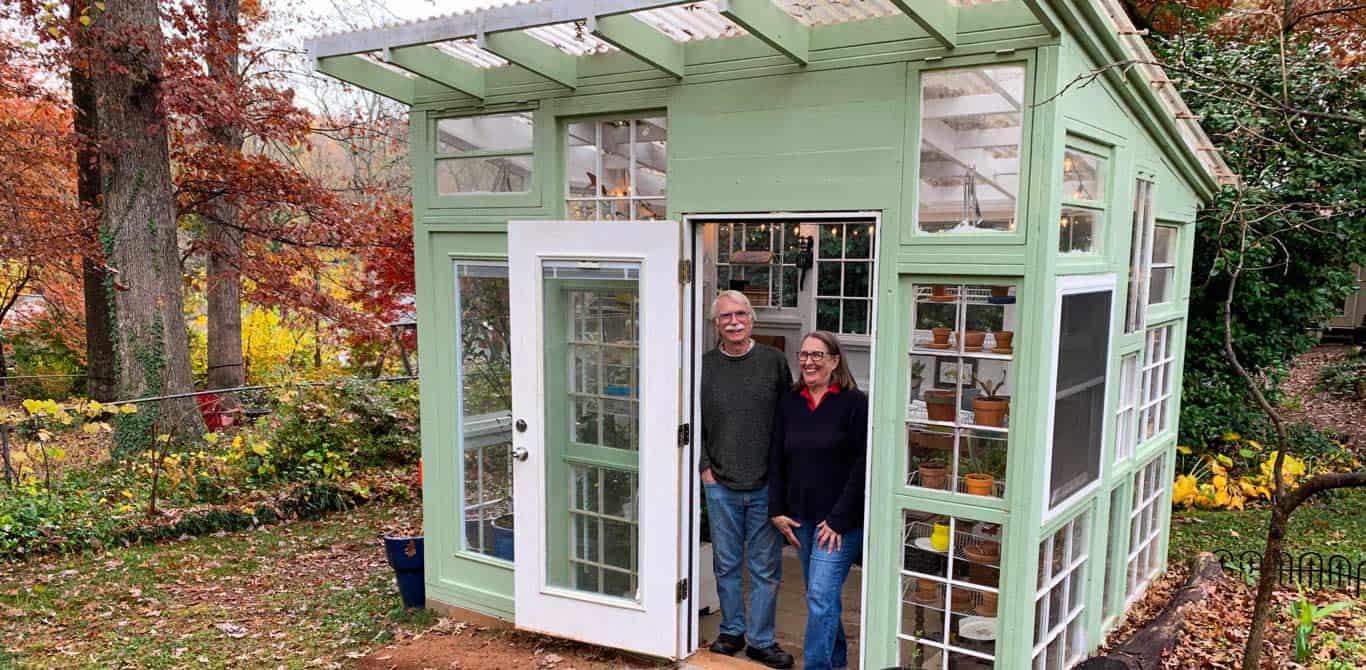
From the back, Ryan’s passive solar greenhouse looks like a house. Yes, it’s party in the front, business in the back, at Ryan’s greenhouse.
The further north you are, the more important it is to maximize insulation/R-values on your north-facing walls and roof/ceiling.
3. Heat-retaining, dark-colored water barrels along north wall placed where winter sun can reach them and summer sun can not
The north-facing interior wall of your greenhouse is where you’ll position your water barrels (or alternative thermal mass materials).
If you can find dark-colored water barrels, great! Get them. The darker the color the better, since they’ll absorb the maximum amount of light, thus heat.
If all you can find is light-colored barrels, then you’ll want to paint them a dark color, black being the most common. Ryan chose purple-colored water barrels in his greenhouse for the following reasons:
“When researching this I found that there was a negligible difference in heat gain when comparing black, dark blue, dark red, and purple. I also found a NASA study that indicated painting walls purple increased flavinoid production in greens. So, I painted my barrels purple.”
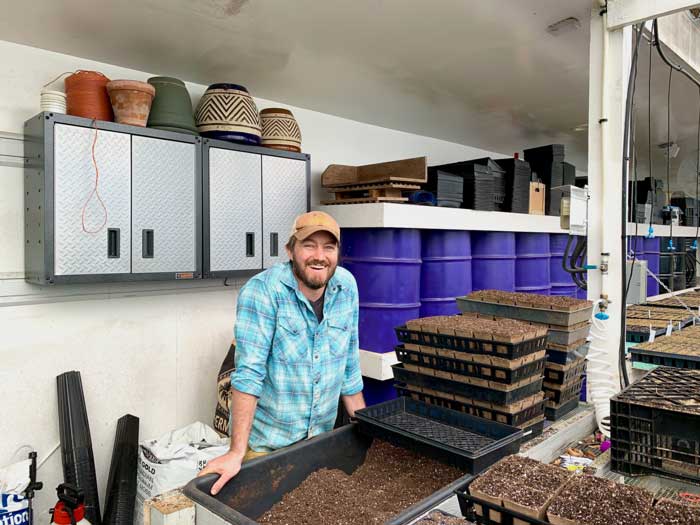
The number/volume of water barrels you get will be determined by the size of your greenhouse and your climate zone. A couple of general rules:
- Aim for 2-5 gallons of water per square foot of glazing (reminder: glazing = transparent surfaces). Warmer climate greenhouses can be towards the lower end of this spectrum while colder climate greenhouses should aim towards the higher end.
- When in doubt, the more water barrels you can add, the better heated your greenhouse will be in the winter.
For reference, Ryan’s greenhouse features (24) 55-gallon water barrels, stacked two high. That’s 1,320 gallons of water to 648 square feet of glazing.
Also important: when planning out the location/design of your passive solar greenhouse, use a sun location app to identify where the sun will be at both the winter and summer solstices. This will not only help you optimally orient your greenhouse’s footprint, it will also help you:
- avoid blocking too much of the winter sunlight with shelving and other items as it passes through the structure towards your water barrels on winter days;
- ensure summer sun is not heating your water barrels (roof and/or overhang positioning is important here).
4. Air circulation/fans
It’s imperative to have good air circulation inside your greenhouse to:
- help even out hot or cold spots,
- move air past your water barrels to bring their winter heat or summer cool out into the structure, and
- help grow healthy and robust, disease-free plants.
Specialized greenhouse fans are the way to go here, which also means you need to have electricity inside your greenhouse. (If you have a very small passive solar greenhouse, you may be able to get away with running an extension cord to a single fan.)
Related to air circulation & fans is venting, the next feature on the list…
5. Venting
A greenhouse traps heat and moisture. Too much of either will stress or kill plants — or cause fungal diseases.
In addition to letting out heat and moisture, your greenhouse venting also lets in fresh air allowing your plants to breathe.
Thankfully, it’s very easy to get automated greenhouse vents, including ones that don’t require electricity. Typically, these vents feature openers with wax cylinders that expand when temps hit 65-75°F, which then automatically pushes the vents open.

Locating vents at both the top and sides of your greenhouse is critical. Placing fans immediately behind roof vents (which automatically come on when the vents open), helps boost both air circulation and cooling efficiency.
Ryan describes his venting/cooling system as follows:
“I have four louvered vents on the upper wall. These open at 72°F (22°C) and that corresponds with the intake vents on the end walls. This would be referred to as Stage 1 cooling in a greenhouse. The two exhaust fans are separate from the exhaust vents but do have louvers that close when they aren’t powered. These fans come on at 85°F (29°C) and would be referred to as Stage 2 cooling. Many greenhouses also have swamp coolers over some of the intake vents. This allows evaporative cooling to occur. This is referred to as Stage 3 cooling.
It’s also critically important that vents and fans are sized appropriately. For passive venting the intake vents need to be double in area to the exhaust vents. For exhaust fans the intake vents need to be 4x the area of the fan.”
6. Electrical
Electricity is essential in a high-performance greenhouse. (You may not need it for a small, home greenhouse though.) Ryan runs fans, lights, and many other electrical devices inside his greenhouse.
He describes his electrical system as follows:
“First, I planned on adding a greenhouse and a barn when we built the house so our electrical panels are sized for expansion. I added a 60 amp breaker in the main panel and a subpanel in the greenhouse.
Each core function in the greenhouse has its own circuit. The heat mats are on a 20 amp isolated circuit and are controlled by a thermostat with a soil probe. The passive cooling intake/exhaust vents are on their own 15 amp circuit controlled by two thermostats. This could have been controlled by one thermostat for all the vents but I had plans for some funky over ride stuff when I initially designed the cooling system.
The exhaust fans are on their own 15 amp circuit and an independent thermostat. The inflation blower and the wall outlets are on another circuit.
I have my irrigation controllers for the misting system, my garden irrigation, and the electric fence powered on this circuit. It’s really a pretty simple system when you get to the bottom of it.”

7. Water/Plumbing/Irrigation
Want a wash station or sink inside your greenhouse? Seedling misting system? Irrigation?
If so, you’ll need to have a dedicated water line going to your greenhouse plus additional plumbing infrastructure.
As Ryan says:
“No one wants to carry water to a greenhouse every day. A plumbed water line is a requirement and if you don’t have a way to keep the greenhouse above freezing then a way to turn off the line and properly winterize it should be included.
You can get super cute in a greenhouse once you have a water line but you can’t expand if you don’t have the initial water source. I also really love my hose trolley system. It was something I never added at the South Carolina Botanical Garden and it should have been a priority.”
What would you do differently?
Ryan has multiple power outlets in his greenhouse but when I asked him what he’d do differently if he could start over he said, “more power outlets.”
Upon later reflection, he also adds other criticisms and wishlist features:
“I think all greenhouses should be bigger. I’ve never been in a greenhouse that was too big — and that includes the 5 acre structures. I also used oil-based paint on the sheetrock because it’s better at repelling water. This was probably my biggest mistake because it will mildew in humid locations. When I redo the plastic in ’25-26 I’ll probably empty the greenhouse and redo the paint with latex.
I would also like to plumb the water barrels into a circulating system that runs through solar hot water panels on the exterior of the greenhouse. This would allow me to increase the heat gain surface using space outside of the greenhouse. It would also allow the potential addition of a geothermal loop which I would consider for cooling.”
When planning your passive solar greenhouse, don’t just think about immediate needs, think about the future and give yourself plenty of runway! Thanks to good pre-planning, Ryan already has the basic infrastructure in place to add new wishlist features and expand his nursery operation.
III. Passive solar greenhouse FAQs
Where do you get passive solar greenhouse supplies?
There are lots of vendors that carry greenhouse supplies, but quality and price vary significantly.
Ryan did a lot of searching and comparison shopping before buying supplies for his passive solar greenhouse. His recommended vendors:
“Almost everything came from Nolt’s Greenhouse Supplies. Other supplies came from Lowes, Home Depot, and Builder’s First Source.”
What’s the minimum number of water barrels needed to heat a passive solar greenhouse?
As detailed earlier: “Aim for 2-5 gallons of water per square foot of glazing (glazing = transparent surfaces). Warmer climate greenhouses can be towards the lower end of this spectrum while colder climate greenhouses should aim towards the higher end.”

When in doubt, go with more thermal mass/water barrels, not less.
In regards to passive solar greenhouse heat sink – is there anything other than water barrels that can be used to trap heat?
While water barrels are the standard heat sink for passive solar greenhouses due to their cost, ease of installation, and effectiveness, you can use materials like dark-colored rocks, bricks, cob, etc.
However, water has a superior volumetric heat capacity to all other common building materials, as we detailed earlier.
Can water barrels also keep a greenhouse cooler in the summer?
Yes, water barrels can help cool a greenhouse in the summer if:
a) they’re positioned to be out of the sun on summer days, and
b) there’s a fan(s) to circulate air around them.
This cooling effect is due to the fact that water inside the barrels is cooler than the outside temperatures.
What’s the farthest north you could use a passive solar greenhouse?
As long as you live in a spot that receives sunlight on the winter solstice, you can utilize a passive solar greenhouse. However, some modifications might be required beyond what we detail in this article.
For instance, University of Minnesota Extension has a helpful guide showing passive solar “Deep Winter Greenhouses” (DWGs) utilized by farmers and gardeners throughout Minnesota. (In case you don’t have a map handy, Minnesota is situated as far north as any of the contiguous states.)
Rather than using water barrels for thermal mass, DWGs blow and store heat energy underground in rock/soil below the greenhouse, which is then released at night. It may be worth considering a DWG design in warmer climates like ours (South Carolina) if you need to maximize your interior growing space while concurrently eliminating heating costs.
Can a passive solar greenhouse be attached to a house?
Yes, passive solar greenhouses can be attached to homes. Often, these setups utilize the south-facing exterior wall of the house as the thermal mass, rather than water barrels.
Special attention will need to be paid to providing a moisture barrier between the home and the greenhouse to prevent mold and rot, especially for wood- and vinyl-sided homes.
It bears repeating that Ryan used and highly recommends the book The Year Round Solar Greenhouse for anyone planning to build their own passive solar greenhouse, so get a copy if that’s you!
We hope this article was helpful and inspirational. Let us know if you have questions or how your own DIY greenhouse turns out!
Other helpful GrowJourney articles you’ll love:
For small farmers:
- Small farm series intro: what is a small, regenerative farm?
- 15 tips to start a small regenerative farm
- What tools & infrastructure does your small farm need to succeed?
- Small farmer choice: CSA vs farmers market vs wholesale
- Should your small farm get certified organic?
For gardeners:



I have a question about the passive solar greenhouse. Did the owner dig down into the ground for the foundation or was it just placed on level ground?
One of the reasons he chose that spot was because the ground was already level. He didn’t dig down; the floor inside is level with the outdoor ground level. In more northern climates, it could certainly make sense to dig down when making a passive solar greenhouse in order to take advantage of the ambient underground heat. You’d just need to make sure your foundation is tight to prevent flooding inside during heavy rains.
Thank you. I think I will build a frame and use gravel inside. It is level ground.
I have a question about ryan mercks greenhouse. Is the vapour barrrier in the insulated walls in the correct location?
tx dennis
Hi Dennis! Response from Ryan: “Probably should have had vapor barrier on both sides… or neither… or does it matter since there is humidity on both sides of the wall? Good question and I’m not really sure.”